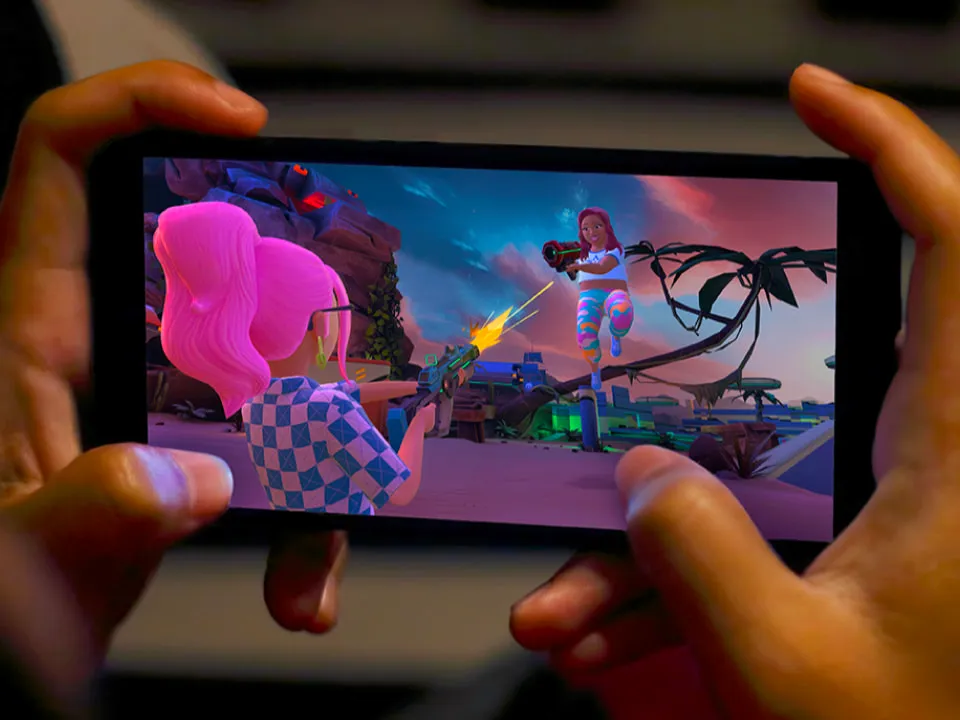
Automating video marketing assets for game developers
In 5 weeks, a research scientist and I built an 8-agent multimodal pipeline that turns mobile gaming assets like images, gameplay clips, and descriptions into short-form social video. In a public Facebook test, its videos beat creator-made reels on game launches, click-throughs, and time spent playing.
Overview
At a glance
My role
Design lead and model designer. I owned what the system needed to do, the agent-to-agent instructions, and the criteria for judging the videos.
Partner
A research scientist who owned the technical architecture
Timeline
5 weeks: 4 weeks to a working prototype, then 1 week of fine-tuning before a public test
Models
Claude, Nano Banana, Veo, and ElevenLabs in the shipped system. Llama, Flux, and Midjourney in early prototyping.
Audience
Meta Horizon game developers and players who discover games through short-form video on Facebook, Instagram, and Horizon.
Results
+17%cross-screen game launches
+11%click-throughs into games
+15%time spent playing
Measured in a public test on Facebook, against creator-made reels.
Meta was sunsetting the VR version of Horizon Worlds and going all in on mobile gaming, where traction was growing among teens and young adults. Mobile game discovery relies on cross-platform promotion, and many teens and young adults find what to play next through short-form video.
Most Meta Horizon creators saw making marketing videos as a distraction from building their games. They're not video creators or marketers. They're game designers and developers, and our research showed they most wanted to hand off marketing and distribution tasks.
Our challenge — could we take assets from thousands of mobile games such as images, gameplay clips, and game descriptions and automatically generate videos good enough to make someone stop scrolling and go play?
Leadership urgently needed a proof of concept to take to our CTO for funding a larger-scale project, and we were told to think in days, not weeks. For us, that meant pixel-perfect polish could wait. The videos just had to be created with full end-to-end automation and be compelling and honest enough about the real gameplay, so nobody felt baited.
01
Dividing the work at the instruction layer
My research scientist partner owned the technical architecture. I owned everything the system needed to do. That meant the system prompts handed from agent to agent to take a game, understand it, and turn it into a video, plus the criteria for judging whether the video was any good. My partner built the scaffolding, and I designed the behavior that ran on it.
Agent pipeline diagram
Game assets
Orchestrator
Game reel creation plan made
Scene Planner
Game reel script generated and input assets chosen
Generated scene path
First frame generator
Input image processed for video generation
First frame quality analyzer
Failed frames get regenerated
Video generator
Captured gameplay path
Video Editor
Captured gameplay video processed
Uses existing gameplay capture instead of generating a new scene.
Scene Stitcher
Scenes spliced together
Music Producer
Background music generated and added to reel
Final game reel created
02
Proving the chain before the infrastructure existed
While my partner wired external models together on internal infrastructure, I was running scrappy tests right on the websites for the models he was exploring at the time — proving out how you could chain an LLM's output into image generation, then into video generation, and then into stitching multiple clips into one coherent video.
I used Llama to write and iterate what became the system prompts for the storyline and scene descriptions. I fed its outputs into Flux, with hand-picked game images, to generate the first and last frame of each scene. Then I fed those frames and prompts into Midjourney to generate each clip, and worked out by hand what the system needed to score a soundtrack and stitch the scenes into a final video.
Each handoff showed me what the next agent and its underlying model needed. That's context engineering in practice. Deciding what information each step gets, and in what shape.
Prototype flow
Prompt input
You are an expert video producer for game trailers.
Your job is to use the supplied game name, description, and reference images to create a trailer that sets the tone for the game. The trailer includes 5 scenes that are each 3-second in length. Follow these directives:
Provide raw descriptions for:
The location, scenery, and art style for the trailer
Each of the 5 scenes that are a single shot. Don't break a scene into multiple shots.
The first frame of each scene.
The last frame of each scene.
Then convert all raw descriptions into prompts for Midjourney. Respond in JSON format.
Prompt experiments
Llama
Creates script and structured prompts for every scene.
Llama outputs into the prototype chain · one set per scene
Llama output
First frame prompt
1 per scene
Uses a reference game image
Model
Flux
Image generation
Output
First frame image
1 per scene
Llama output
Last frame prompt
1 per scene
Uses the generated first frame
Model
Flux
Image generation
Output
Last frame image
1 per scene
Llama output
Video prompt
1 per scene
Uses the first and last frame images
Model
Midjourney
Video generation
Output
Video clips
1 per scene
Manual assembly
Stitch
Manually stitch all scenes and add music
03
Turning a video producer's craft into scene plans
I'm not a video expert, so I borrowed one. I recruited an in-house video producer who wrote storyboards for Horizon's professionally produced game trailers. I asked him for a few storyboard templates. A template might call for 16 seconds and four scenes with fast, energetic music. First a wide third-person action shot, then a close shot of the core mechanics, then a celebration, then a still of the game's title slate.
I turned each template into machine-readable instructions for our scene-planning agent, which generated a script and scene plan that every other agent built from. The scene plan was the context the rest of the system depended on.
producer-template.md
16 seconds — 4 scenes

Music — Fast and energetic

Scene 1 — 3rd person wide shot action cam
  • full gameplay action
  • 4 seconds
  • cut — instant

Scene 2 — close shot / insert shot
  • core gameplay / mechanics
  • 4 seconds
  • cut — instant

Scene 3 — close shot celebration
  • celebration
  • 4 seconds
  • cut — instant

Scene 4 — still game slate image
  • game title image
  • 4 seconds
04
Defining what the system could see
I also set the creative and technical requirements for the game assets the system took in, including images, gameplay captures, and metadata. That work became the backbone of our input-asset pipeline, the follow-on system for gathering game assets our agentic video-generation system could use.
One core piece of the input-asset pipeline was a game description generator that took a game's listing description and metadata and produced a description tailored specifically for creating a video short about the game.
Game input assets
Image capture
Video capture
Description
Metadata
05
Debugging the hand-offs
When something failed in the generation process, I analyzed the JSON data in the session logs to see what each agent handed off to the next agent in the workflow. This helped me understand the instructions different agents wrote based on my instructions, so I could debug where in the system something failed and why. At the time, it was a lot of system sleuthing by hand, a task I'd now use Claude Code to do. But it gave me a deep technical foundation of the system as a whole, allowing me to help others understand it and pinpoint issues as it became more complex over time.
03
The trade-off
In five weeks, ReelsForge went from concept to 26 generated videos in a public test that showed measurable engagement lifts and outperformed reels creators made by hand. But the most lasting outcome wasn't any single video. The asset pipeline and evaluation framework I defined became foundational infrastructure for how we've evolved the system over time.
Video progression
Prototype
Prototype result
Some refinements
Progression video
Public test
Progression video
In the public test on Facebook, generated videos beat creator-made videos. They drove 17% more cross-screen game launches, 11% more click-throughs into games, and 15% more time spent playing among people who clicked through.
That win lit a fire. The team grew fast, my research scientist partner moved on to other work, and the asset pipeline and quality criteria we started defining became the foundation for how the team improved the system from there.